By Marcello Salles – Partner, Corporate Finance, and Rafael Igrejas – Director, Corporate Finance
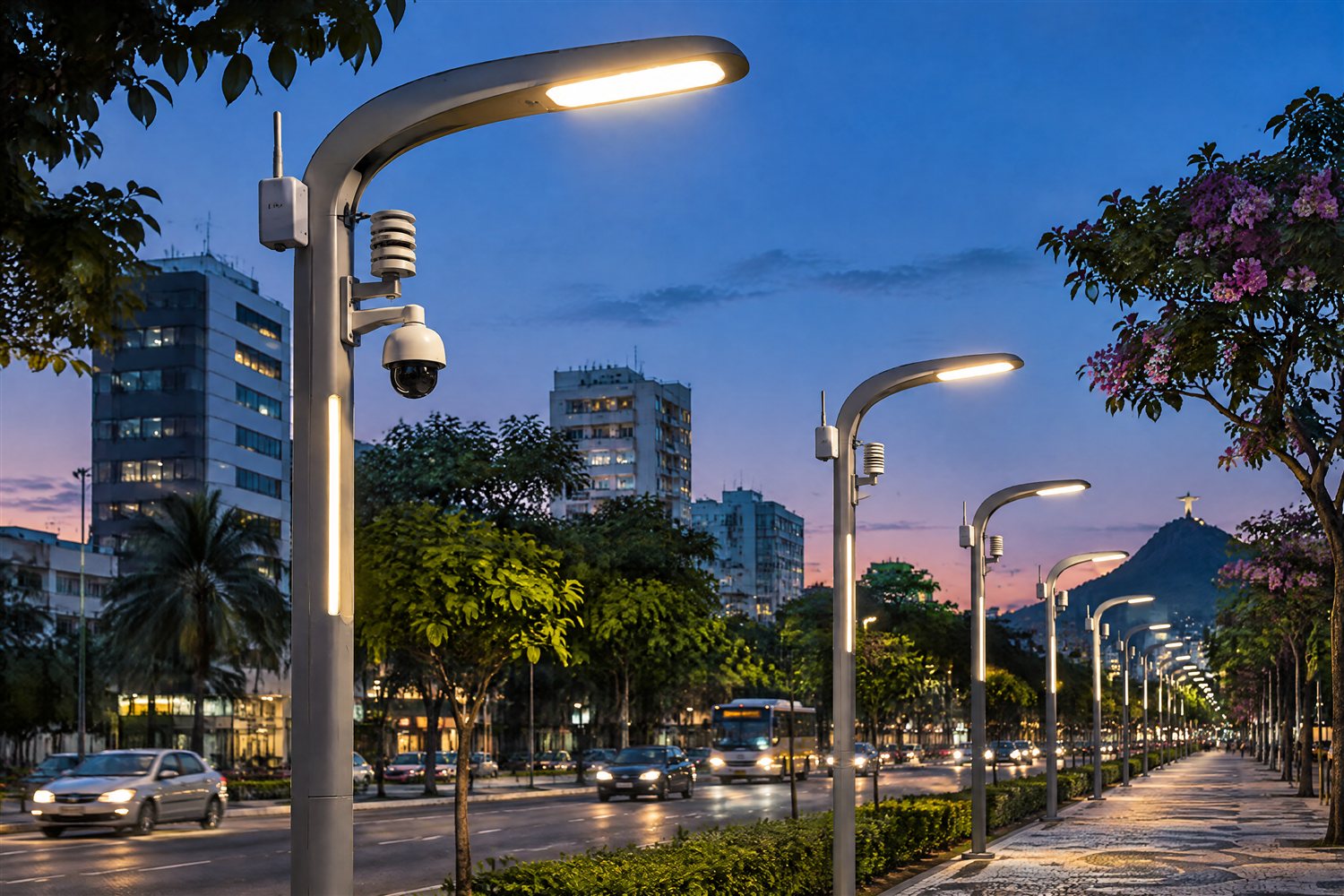
For a long time, talking about public lighting meant talking about changing light bulbs. That has changed! The lamppost is no longer just a point of light and has started to work as an urban platform, with remote management, cameras, connectivity and sensors, all financed in an integrated way, taking advantage of the flexibility of the COSIP account (the municipal contribution that funds public lighting).
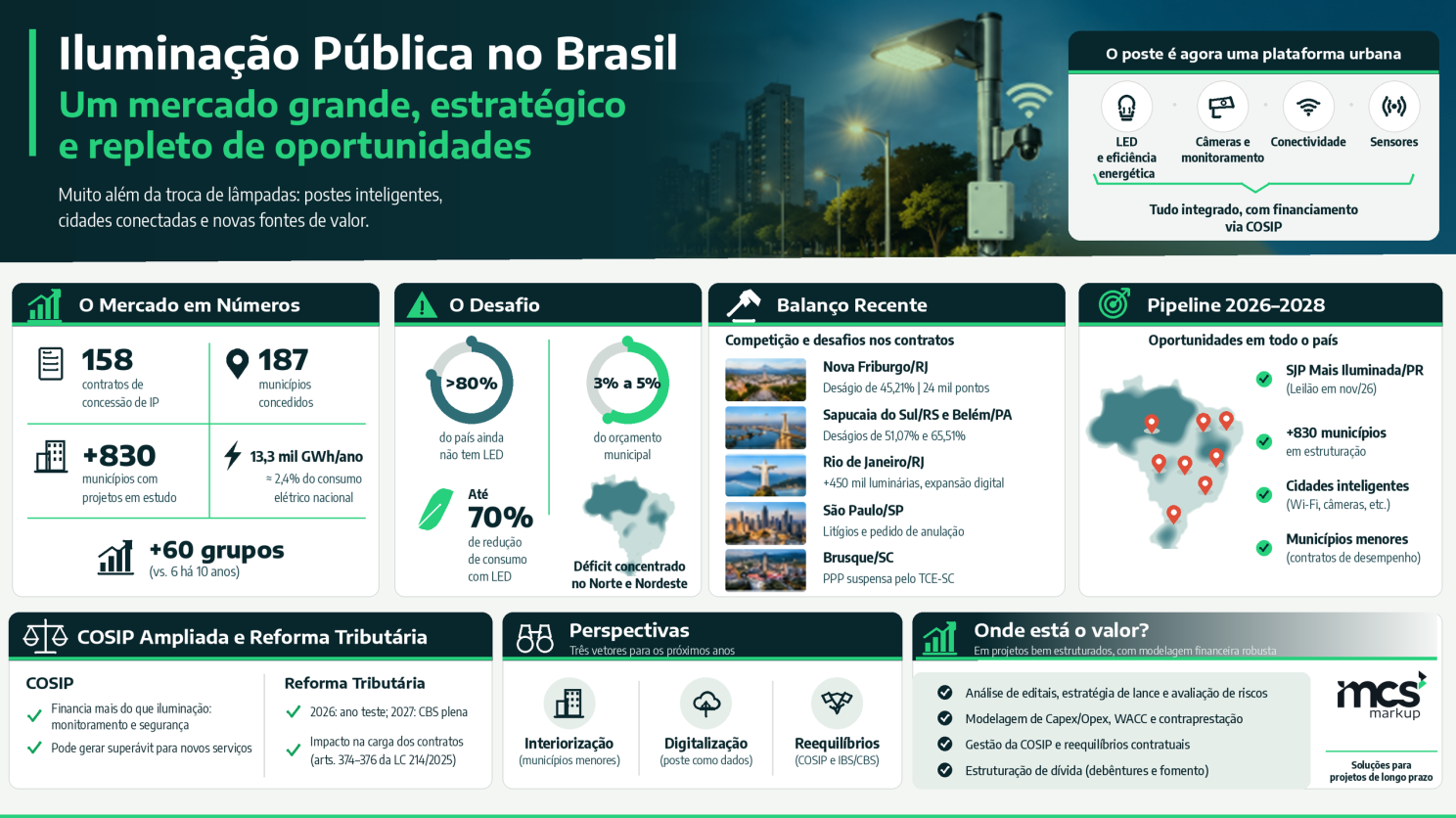
The numbers help gauge the scale of this movement. According to the Brazilian Association of Public Lighting and Smart City Concessionaires (ABCIP, 2026), there are already more than 158 public lighting concession contracts in 187 municipalities, and more than 830 municipalities have public lighting and smart city concession projects under development. In this context, public lighting consumes 13,300 GWh per year, around 2.4% of national electricity consumption, according to Brazil’s Energy Research Office (EPE, 2026). A decade ago, only 6 groups operated these concessions; today there are more than 60.
Looking at the coming years, it is worth reflecting on the challenges, on what recent contracts and auctions reveal, on where the opportunities lie through 2028/2030 and on how Brazil’s Tax Reform and the expanded COSIP change the equation for projects.
A large but still underexplored market
More than 80% of the country still does not have LED lighting (ABCIP), and the switch can reduce energy consumption by up to 70%. At the same time, lighting takes up between 3% and 5% of municipal budgets. In other words, there are significant savings waiting to be captured, and these savings are what usually justify the investment.
In a universe of more than 5,500 cities, with 187 municipalities under concession, there is still a strong concentration in the largest municipalities, which have access to capital and technical staff. For smaller municipalities, EPE points to fiscal constraints and the lack of a national database, which makes it difficult to compare cities, estimate energy savings and prioritize projects. For those structuring projects, gathering data and building regional relationships remain a challenge that comes before modeling.
Recent results: competitive bidding, risk in contracts
Nova Friburgo/RJ. The 13-year PPP was auctioned on B3 (the Brazilian stock exchange) on May 28, 2026, and won by Tradetek, with a monthly consideration payment of R$577,000 and a 45.21% discount. Capex is R$95.8 million, with 24,000 light points modernized within 12 months (around 33,000 by the end).
Sapucaia do Sul/RS and Belém/PA. In the 2020 tenders, discounts reached 51.07% in Sapucaia (8 competing bids) and 65.51% in Belém, where around 90,000 light points were modernized within 24 months.
Rio de Janeiro/RJ. The Smart Luz PPP, with more than 450,000 luminaires and R$925 million in financing, shows the path of digital expansion: there were 25,438 remotely managed light points in 2025, and the goal is to reach 63,000 by the end of 2026.
São Paulo/SP. The Ilumina SP contract (20 years, R$6.9 billion, signed in 2018) is the target of a request for annulment and a R$1 billion asset freeze by the São Paulo State Public Prosecutor’s Office (MP-SP), partly because of an amendment that added traffic lights without a public tender (an additional R$3.8 billion through 2038). The concessionaire and the City Government contest this, citing 67% energy savings and investments already made.
Brusque/SC. The 25-year PPP (R$356.5 million), which combines lighting, fiber optics and urban intelligence, was suspended by the Santa Catarina State Court of Audit (TCE-SC) in October, with a focus on the proof of concept.
In our view, the results tell two stories at the same time:
- Competition exists: discounts of between 45% and 65% on the maximum consideration payment indicate appetite and room for efficiency. But such high discounts also raise a red flag about the sustainability of cash flow over the life of the contract;
- Legal risk weighs heavily: litigation and suspensions by State Courts of Audit (TCEs) show that amendments, expanded scope and poorly defined proofs of concept can stall projects and affect asset value;
- Fragmented information: data is spread across city governments, B3 and TCEs, and the pipeline requires checking tender notice by tender notice. Those who do this analysis carefully tend to price better.
Pipeline 2026-2028: where the value lies
São José dos Pinhais/PR. The “SJP Mais Iluminada” project (LED and remote management) is the auction with the nearest date: bid envelopes on November 17 and the session on B3 still in November 2026. Dates are still subject to challenges and to the State Court of Audit (TCE).
More than 830 municipalities in the structuring phase. ABCIP highlights Minas Gerais, Bahia, São Paulo and Rio Grande do Sul, with Caixa (Brazil’s federal savings bank) and BNDES (Brazilian Development Bank) as pioneering project structurers. Most of the pipeline still has no tender notice or date and should gain traction from 2027 onward.
Smart cities. There are already 36 contracts with two or more services beyond lighting (Wi-Fi, video, weather, solar), and around 180 municipalities have shown interest in integrated PPPs. This is where telecom operators, tower companies and fiber providers come in, with pole sharing and ancillary revenues.
Smaller municipalities. Performance contracts (ESCO) and intermunicipal consortia are the natural path to gaining scale, although we have not yet seen new consortia being formed.
On the financing side, there are instruments available: Procel Reluz, PEE/ANEEL, Pró-Cidades, Fundo Clima, BNDES and incentivized public lighting debentures. With the Selic rate (Brazil’s benchmark interest rate) at 13.75% and Capex concentrated in the early years, the capital structure becomes as decisive as the bid.
Expanded COSIP and the Tax Reform: the equation changes
Constitutional Amendment (EC) No. 132/2023 expanded the use of COSIP, which can now also fund security monitoring systems and the upkeep of public spaces. In practice, municipalities that generate a surplus after switching to LED can direct resources to video, connectivity and sensors.
On the other hand, the regulations are still incomplete: legal analyses indicate that the argument for funding smart city initiatives with COSIP is not yet solid or replicable, and ABCIP is calling for priority to be given to modernization and for clear criteria.
Under the Tax Reform, the timeline is the same as for other sectors: 2026 is a test year; in 2027, the CBS (federal Contribution on Goods and Services) comes fully into force and PIS/Cofins (federal contributions on revenue) are abolished; between 2029 and 2032, ICMS (state tax on goods and services) and ISS (municipal service tax) are gradually reduced; and in 2033 the new regime comes fully into force. The CGIBS (IBS Management Committee) estimates the new reference rate at 30%, by adding the CBS’s 11.3% to the projected 18.7% for the IBS (Tax on Goods and Services, shared by states and municipalities), exceeding the 26.5% ceiling initially projected.
The migration to IBS/CBS may change the effective tax burden on the consideration payment. In our view, Articles 374 to 376 of Complementary Law (LC) No. 214/2025, which guarantee economic and financial rebalancing for existing concessions, also apply to public lighting PPPs. Those who approach the granting authority with the tax burden calculated contract by contract will have an advantage.
Outlook
Three movements are set to define public lighting through 2028! The first is expansion into the interior: the market moves beyond the large cities and reaches hundreds of smaller municipalities, which need simpler models, consortia and tailor-made financing. The second is digitalization: the lamppost becomes data infrastructure, and new services come in through amendments and integrated PPPs. The third is the rebalancing agenda, with the expanded COSIP, IBS/CBS and litigation reshaping contracts that have already been signed.
On all these fronts, economic and financial modeling determines who wins the project and who sustains the contract. This is the space in which MCS Markup’s Corporate Finance team operates: modeling of public lighting PPPs and concessions (consideration payment, Capex/Opex, WACC and maximum discount), bidding strategy and tender notice analysis, COSIP capacity and backing for the consideration payment, rebalancing claims with supporting calculations, IBS/CBS tax burden by contract, valuation, due diligence and debt structuring with incentivized debentures and credit lines from development banks.
Have questions or want to know more about this topic? Contact MCS Markup.